
Dark graphic novels push the medium to its extremes by confronting violence, trauma, morality, and psychological depth in ways prose or film often can’t. From our perspective, the Super Pig Bros, these stories don’t exist to shock for shock’s sake—they exist to test what visual storytelling can hold without breaking.
We’ve seen this play out over time. When creators lean fully into darkness with intent and craft, graphic novels become a space where difficult ideas can be explored honestly, not safely.
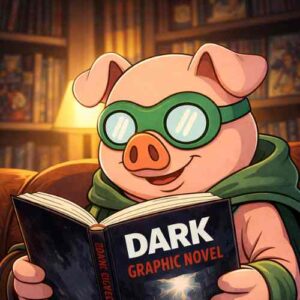
Table of Contents
What Makes a Graphic Novel “Dark” — and Why It Matters
Dark graphic novels aren’t just about grim aesthetics or bleak endings. They’re defined by how they use the medium to explore uncomfortable truths, often through silence, pacing, and visual symbolism rather than exposition.
These books matter because they expand what graphic storytelling is allowed to be. They refuse the idea that comics must soften impact to remain accessible.
Chill notes:
“Darkness isn’t the goal. Honesty is. Darkness is just the consequence.”
How Dark Graphic Novels Push the Medium Itself
Unlike prose, graphic novels control time visually. A single panel can linger on a moment of horror, grief, or realization longer than words ever could.
Creators use negative space, fragmented layouts, and unreliable visuals to reflect fractured mental states. This is where the medium stops being illustrative and becomes psychological.
That experimental edge is part of why many of these works later influence adaptations, including the kinds of projects explored in Top Motion Comic Adaptations.
Graphic Novels That Truly Push the Limits
The following works aren’t just dark in tone. They challenge form, reader comfort, and narrative expectation in ways that permanently altered the landscape of graphic storytelling.
1. Watchmen by Alan Moore and Dave Gibbons
Often cited as the turning point for mature comics, Watchmen dismantles the superhero myth from the inside. Its darkness comes from moral ambiguity, not violence alone.
The rigid panel structure creates a cold, controlled reading experience that mirrors the story’s emotional distance.
Ace adds:
“It’s not just dark—it’s surgical.”
2. From Hell by Alan Moore and Eddie Campbell
This sprawling, unsettling work uses the Jack the Ripper murders to examine power, misogyny, and institutional decay. Its rough, almost unfinished art style reinforces the discomfort.
From Hell proves that darkness can be intellectual as well as visceral.
3. The Sandman by Neil Gaiman (select arcs)
While not uniformly dark, The Sandman reaches extreme emotional depths in arcs dealing with death, madness, and destiny. Horror here is existential rather than graphic.
It expanded what long-form serialized graphic novels could attempt thematically.
Dapper says:
“This series trusted readers to sit with discomfort instead of resolving it.”
4. Maus by Art Spiegelman
Maus remains one of the most devastating uses of the medium. By portraying the Holocaust through anthropomorphic figures, it creates distance that paradoxically increases emotional impact.
The darkness lies in restraint, memory, and the weight of survival.
5. Black Hole by Charles Burns
Set against the backdrop of adolescence, Black Hole uses body horror as metaphor for alienation and fear. The clean, stark art contrasts brutally with the subject matter.
It’s a masterclass in using genre aesthetics to explore internal trauma.
6. Arkham Asylum: A Serious House on Serious Earth
This graphic novel abandons conventional storytelling for surreal, symbolic horror. The artwork is chaotic, dreamlike, and often disorienting.
It pushes readers to experience madness rather than observe it, redefining how familiar characters can be portrayed.
7. The Crow by James O’Barr
Born from personal grief, The Crow channels raw emotion through gothic violence and poetry. Its darkness is sincere, not calculated.
The book’s influence stretches far beyond comics, but the original work remains unmatched in emotional intensity.
Chill reflects:
“You feel the pain because it was never filtered.”
8. Scalped by Jason Aaron and R.M. Guéra
Scalped combines crime fiction with cultural critique, delivering unrelenting violence alongside moral complexity. There are no clean heroes, only consequences.
It’s a sustained exploration of cycles that graphic novels are uniquely suited to portray.
9. My Friend Dahmer by Derf Backderf
This unsettling memoir chronicles the author’s teenage acquaintance with Jeffrey Dahmer. Its power comes from normalcy rather than sensationalism.
The darkness lies in recognizing how horror can grow unnoticed.
10. The Dark Knight Returns
This work redefined how far mainstream characters could be pushed into dystopian territory. Its brutal tone and fragmented media commentary influenced decades of storytelling.
It proved that even iconic figures could exist in morally bleak worlds without losing narrative weight.
Why These Stories Endure
Dark graphic novels last because they don’t rely on shock alone. They use darkness as a tool to explore humanity, systems, and identity with precision.
Readers return to them not for comfort, but for clarity.
Many of these works are now considered essential reading, frequently appearing in discussions around Best Graphic Novels of All Time and serving as gateways into more mature storytelling like those highlighted in Best Graphic Novels for Adults.
Darkness Isn’t a Genre — It’s a Commitment
The most effective dark graphic novels don’t ask whether readers are comfortable. They ask whether readers are willing to engage honestly.
From our perspective, the Super Pig Bros, that willingness is where the medium becomes art rather than entertainment.
Ace sums it up:
“When a story risks losing you, it often gains something more important.”