Stories evolve—and comics have always led the charge. We’ve watched it happen from both sides of the panel. We’re the Super Pig Bros: lifelong comic readers who somehow ended up becoming superheroes inside the medium itself. From ink-stained pages to glowing screens, we’ve lived the shift firsthand.
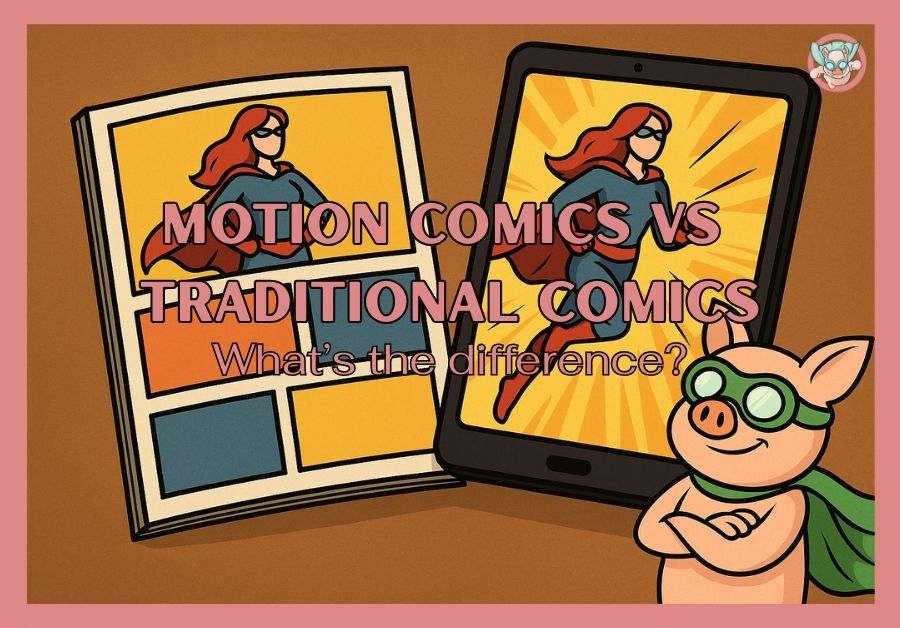
That brings us to one of the biggest conversations in modern comic storytelling: motion comics vs traditional comics. Classic print comics deliver the timeless, panel-by-panel experience that shaped generations of readers. Motion comics, on the other hand, blend artwork, sound, and movement to create a digital-first hybrid that’s changing how stories are consumed.
So what really separates traditional comics from motion comics? Why do some fans swear by the printed page, while others dive headfirst into animated panels and soundtracks?
Let’s break it down—hero to hero.
Table of Contents
Defining the Formats
Traditional comics are the foundation most of us grew up with. Printed—or digital—panels unfold in deliberate sequence, using artwork, dialogue bubbles, and written sound effects to tell the story. The reader controls the pace. You can linger on a single frame, reread a line of dialogue, or study the details that define some of the 10 best action super hero comics ever created.
Motion comics approach storytelling differently. They layer movement, voice acting, sound effects, and music onto existing comic art. They aren’t fully animated shows, but they’re not static pages either. Think of them as a middle ground—your favorite panels remain intact, but they now flow in a timed, cinematic way.
Ace’s take: Motion comics feel like listening to an audiobook while flipping through the illustrated edition. You’re still experiencing the original art, but the delivery reshapes how the story lands.

The Reading Experience
Here’s the big divide: control of pacing.
- In traditional comics, you decide how fast the story unfolds. You can pause to study a splash page, skip back, or race ahead. Silence plays a role too—you imagine voices, sound effects, and tone.
- In motion comics, pacing is set for you. The voiceover dictates the speed of dialogue, the panel transitions control timing, and the soundtrack fills in the silence. It’s more like watching a short film than reading a book.
Both experiences have their strengths. One prioritizes introspection and imagination. The other leans into immersion and atmosphere.
Chill’s take: Traditional comics are like a long hike where you stop whenever you want. Motion comics are like a guided tour—you get the full experience, but you’ve got to walk at the group’s pace.
Visual & Audio Differences
Traditional comics lock each moment in place. The artist chooses the panel structure, the poses, and the details you see. Sound is implied through text: “BOOM!”, “SNIKT!”, or whispered dialogue written in italics.
Motion comics build on that foundation with:
- Animated transitions (zooms, pans, or subtle character movement).
- Voice acting, which can be one actor reading all parts (Watchmen) or a full cast (Astonishing X-Men).
- Music and effects that create mood and reinforce the story’s energy.
The risk? Too much animation can break the comic’s charm, while weak voice acting can pull you out completely.
Dapper’s take: Voice casting is everything. A flat performance can drag down even the most iconic story.
Accessibility & Audience
Traditional comics thrive with collectors and lifelong fans. There’s a culture of bagged-and-boarded issues, conventions, and the joy of owning a complete run. Even in digital form, platforms like ComiXology preserve the “reader controls the pace” structure.
Motion comics shine online. They’re easily shared on YouTube, quick to stream, and perfect for drawing in people who’ve never picked up a comic book before. For someone new, watching Black Panther: Who Is the Black Panther? is often easier than buying the trade paperback.
If you’re curious to explore, we put together the Best Motion Comics on YouTube—a curated list of standouts worth watching right now. We’ve also dived deeper into the entire production process for Motion Comics with our article on exactly What is a Motion Comic.
Ok, let’s jump into some awesome examples!
Notable Examples
Watchmen
Alan Moore and Dave Gibbons’ landmark graphic novel got a faithful, if controversial, motion comic treatment. Every line of dialogue was voiced by one actor, giving it a strange but haunting theatrical feel.
Our take: It’s jagged, awkward, and sometimes clunky—but it mirrors the story’s fractured morality.
Black Panther: Who Is the Black Panther?
Before the MCU film, this motion comic introduced a wider audience to Wakanda. Strong voice work, bold transitions, and cultural soundscapes gave it life.
Our take: It’s vibrant and proud, a great showcase of how sound and movement can amplify existing art.
Iron Man: Extremis
This Marvel Knights project captured Warren Ellis and Adi Granov’s sleek tech-driven story. The motion effects enhanced Granov’s ultra-modern art style.
Our take: Iron Man was made for motion comics. The tech aesthetic feels even sharper when panels come alive digitally.
Thor & Loki: Blood Brothers
Esad Ribić’s painted art already felt mythic. The motion comic leaned into operatic pacing, swelling music, and atmosphere.
Our take: One of the most cinematic motion comics ever produced.
Astonishing X-Men
Joss Whedon and John Cassaday’s revival of Marvel’s mutants translated beautifully into motion. With solid voice work and smart pacing, it’s one of the most polished motion comics around.
Our take: This is where Marvel found its groove. If you want to try motion comics, start here.

Industry & Cultural Impact
Traditional comics carry the full weight of history. Decades of publishing, landmark storylines, conventions, and shared fandom have shaped the medium into what it is today. Many of the most influential superhero comics were born on the printed page, setting standards for storytelling, art, and cultural relevance that still guide the industry.
Motion comics, by contrast, remain more niche—but quietly influential. They proved that comic storytelling could extend beyond print into digital-first formats without losing its identity. Marvel Knights pushed the form aggressively in the 2000s, while DC experimented with projects like Watchmen. At the same time, fans embraced the medium, creating unofficial motion comics that drew millions of views and expanded how audiences engaged with these stories.
Today, official motion comic adaptations live on brand platforms, while unofficial versions thrive on YouTube. Motion comics aren’t replacing traditional comics—but they’ve earned their place alongside them, expanding how some of the most influential superhero stories are experienced by new generations.
The Future of Both
Print isn’t going anywhere. Fans will always want physical books to collect, flip through, and display. Digital readers have only expanded that reach.
Motion comics, however, might evolve. With VR, AR, and interactive storytelling, we could soon see comics that combine traditional panel art with immersive tech. Imagine standing inside a panel, hearing the dialogue around you, while still seeing the original artwork. That’s where the medium could go.
Conclusion
At their core, the difference between motion comics and traditional comics comes down to control and immersion. Traditional comics hand control to the reader, letting imagination fill the gaps. Motion comics seize the reins, creating an experience closer to cinema.
Both have value. Both matter. And both deserve a place in the future of storytelling.
Chill’s final word: Read them, watch them—just don’t miss the stories.
Ace’s final word: Motion comics are experiments worth celebrating.
Dapper’s final word: But nothing beats holding the real thing in your hands.