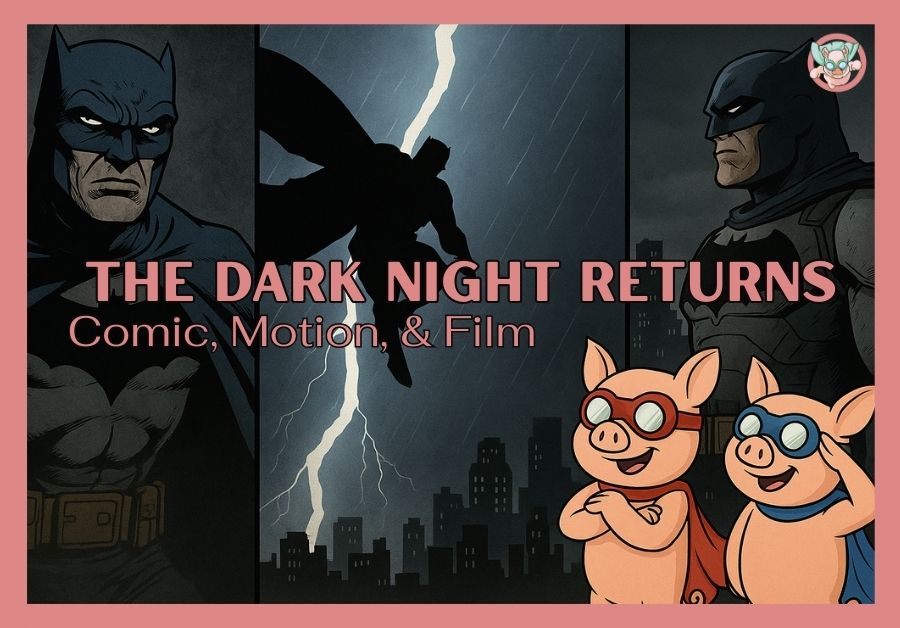
Few stories in Batman’s history are as defining as The Dark Knight Returns. When Frank Miller’s four-part series hit shelves in 1986, it didn’t just reinvent Batman—it redefined superhero comics. Gritty, unapologetic, and unflinching in its political undertones, the story set a new bar for mature, complex storytelling in comics.
Since then, The Dark Knight Returns has lived multiple lives: the original comic, a motion comic adaptation, and a two-part animated film. Each format delivers the same story in very different ways. In this case study, we’ll explore how each version stacks up, what makes them unique, and which one is right for you.
Table of Contents
The Comic (1986)
Frank Miller, alongside Klaus Janson (inks) and Lynn Varley (colors), delivered a Gotham unlike any we’d seen before. Bruce Wayne, now in his 50s, has retired as Batman. Gotham has sunk deeper into corruption, crime, and despair. Unable to sit back any longer, Wayne dons the cowl once more—older, angrier, but still determined.
- Tone: Brutal, dystopian, heavy with political commentary.
- Style: Dense panels, multiple narrative threads, and heavy use of TV commentary as background noise.
- Impact: This book influenced every Batman adaptation that followed, from Tim Burton’s 1989 film to Christopher Nolan’s The Dark Knight Rises.
Chill’s take: The comic is raw. It’s not trying to entertain so much as challenge how you see Batman.
For those who want to go deeper into how comics and motion comics differ in reading experience, we break this down in The Difference Between a Motion Comic and Traditional Comic.
The Motion Comic
In the 2000s, The Dark Knight Returns was adapted into a motion comic. Unlike the animated film, the motion comic sticks to Miller’s original artwork, adding subtle movement, narration, and sound effects.
- Format: Original comic panels enhanced with zooms, pans, and minor animation.
- Strengths: Faithfully keeps Miller’s artwork and text intact. Hearing Bruce’s inner monologue read aloud adds new depth.
- Weaknesses: Limited animation feels stiff compared to modern standards. Voice acting doesn’t always land.
- Reception: A niche favorite—especially for fans who want the comic’s intensity but with a touch of audio immersion.
Ace’s take: This one’s for purists. If you respect Miller’s panels as gospel, the motion comic is the closest thing to hearing them breathe.
Curious about how motion comics are produced? Our guide on What is a Motion Comic breaks down the process step by step.
The Animated Film (2012–2013)
Warner Bros. Animation turned The Dark Knight Returns into a two-part animated feature. Unlike the motion comic, the film goes for cinematic polish while staying remarkably faithful to the source.
- Part 1: Focuses on Bruce’s return, his confrontation with Harvey Dent, and the rising Mutant gang.
- Part 2: Brings in the Joker’s final act and Batman’s showdown with Superman.
- Voice acting: Peter Weller (of RoboCop fame) voices Batman, bringing gravitas and weariness to the role.
- Strengths: Fluid animation, strong voice cast, and action sequences that leap off the page.
- Changes: Some streamlining for pacing, but overall one of DC’s most faithful animated adaptations.
Dapper’s take: This is the most watchable version for newcomers. It captures the story’s grit without feeling dated.
For fans who enjoy exploring other publishers’ adaptations too, we’ve ranked the Best Marvel Motion Comics for comparison.
Comparing the Three Versions
Each format delivers something different:
- Comic: The most layered, dense, and politically sharp. Demands focus but rewards it.
- Motion Comic: Faithful to the panels, rough around the edges, but immersive for fans of the original.
- Film: Polished, cinematic, and the most accessible for new audiences.
Chill’s take: The comic is the history book.
Ace’s take: The motion comic is the museum exhibit.
Dapper’s take: The film is the blockbuster trailer that still gets the point across.
If you’d like to see how The Dark Knight Returns stacks up against other adaptations, check out Top Motion Comic Adaptations—we cover Watchmen, Black Panther, and more.
Legacy & Influence
The Dark Knight Returns reshaped Batman’s cultural image:
- Film & TV: Inspired Burton’s gothic tone, Nolan’s psychological realism, and Snyder’s armored Batman vs. Superman battle.
- Comics: Paved the way for darker reinterpretations, from Batman: Year One to Batman: Hush.
- Pop culture: The armored Batsuit, the older and grizzled Bruce, the political undertones—all trace back to Miller’s work.
The story’s continued adaptations show how one narrative can live across mediums while still feeling relevant.
Chill’s take: Without this book, Batman might still be defined by camp.
Ace’s take: It’s not just a comic. It’s a manifesto.
Dapper’s take: Every Batman story since owes this one a debt.
Where to Start
If you’re brand new to The Dark Knight Returns:
- Read the comic to experience the full impact of Miller’s writing and Gibbons’ artwork.
- Watch the animated film for a faithful, modernized adaptation with cinematic polish.
- Check out the motion comic if you’re curious about how the original panels sound when narrated.
For more great recommendations, we’ve put together the Best Motion Comics on YouTube—a guide to finding adaptations you can stream right now.
Conclusion
The Dark Knight Returns proves that a single story can thrive across multiple formats. The comic remains the definitive text—dense, dark, and transformative. The motion comic preserves that raw art with added immersion, while the animated film delivers the most polished, accessible experience for today’s audiences.
Whichever version you choose, you’ll be stepping into one of the most influential Batman stories ever created (one of the most influential superhero comics)—one that continues to shape the Dark Knight’s legacy to this day.
Written by the Super Pig Bros — Chill, Ace, and Dapper