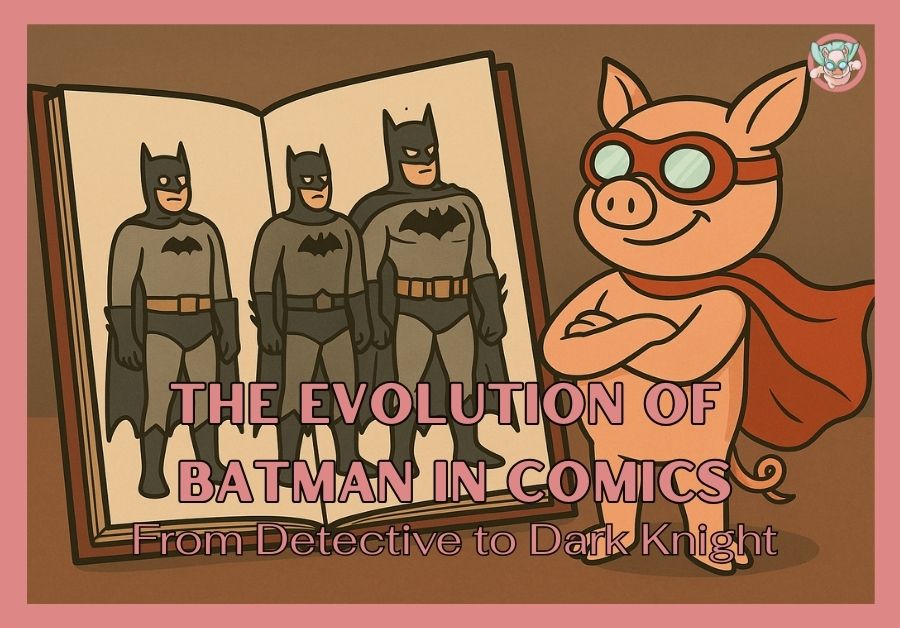
Batman has worn many faces since his debut in 1939: trench-coat detective, campy crusader, gothic avenger, and global symbol. Each era reshaped him to fit its time, yet he’s always remained the same relentless force against Gotham’s darkness. This is the story of how the Caped Crusader evolved—from detective to Dark Knight.
Table of Contents
1939 – 1950
When Batman first appeared in Detective Comics #27 in 1939, he wasn’t the polished, mythic figure we know today. He was a pulp-inspired vigilante with a gun in his hand, chasing criminals across rooftops with grim determination. To us, that Batman feels raw and dangerous—born from the same shadows that produced hardboiled detectives and masked avengers like The Shadow. But even in those early days, his world was beginning to form.
Within a year, Robin arrived to balance the darkness with youthful energy, and the first versions of the Batcave, Batmobile, and utility belt turned him into a detective who relied as much on ingenuity as intimidation. His earliest foes—Joker, Catwoman, Penguin—were simple archetypes at first, but they planted the seeds of a rogues’ gallery unlike any other.
1950 – 1980
Then came the 1950s and the Comics Code Authority. The gritty pulp stories gave way to smiling sci-fi adventures. Batman wasn’t just battling mobsters anymore—he was fighting aliens, traveling through time, and teaming up with Bat-Mite. To many fans, this was a weird detour, but it kept him alive when censorship nearly crushed the medium.
The “New Look” in 1964 tried to steady the ship—giving him the now-iconic yellow oval on his chest and sharpening his detective roots—but the real cultural shift came from the Batman TV show in 1966. Adam West’s campy crusader was everywhere, a pop phenomenon. Kids loved it, adults mocked it, and for better or worse, Batman’s public image was “silly” for a generation.
The 1970s changed everything again. Denny O’Neil and Neal Adams dragged Batman back into the shadows, stripping away the camp and giving Gotham its gothic mood once more. The Joker was reimagined as a homicidal maniac instead of a prankster, and new villains like Ra’s al Ghul added mythic depth. Steve Englehart and Marshall Rogers followed with noir-infused tales that showed Gotham as paranoid, strange, and alive. For us, this is the era where Batman rediscovered himself—as a detective first, a superhero second.
1980 – 2010
But it was the 1980s that permanently reforged the Dark Knight. Frank Miller’s The Dark Knight Returns\ showed us an aging, brutal Batman in a near-future world, redefining him as a cultural icon. Miller’s Year One grounded his origin in street-level grit. Alan Moore and Brian Bolland’s The Killing Joke explored the fragile psychology linking Batman and the Joker, while Grant Morrison’s Arkham Asylum plunged into surreal psychodrama. These weren’t just comics anymore; they were literature. And when Tim Burton’s 1989 Batman film hit, drenched in gothic style, the loop between page and screen locked in.
The 1990s pushed Batman through events that broke and rebuilt him. Fans famously voted to kill Jason Todd in A Death in the Family. Bane snapped his back in Knightfall, forcing others to wear the cowl. Gotham itself was torn apart in No Man’s Land, forcing Batman and his allies to survive in an isolated, lawless city. At the same time, Jeph Loeb and Tim Sale gave us The Long Halloween, a sprawling murder mystery that reminded everyone Batman is first and foremost a detective. The stakes were higher than ever, and Batman felt mortal.
The 2000s were about legacy and reinvention. Hush delivered a blockbuster mystery with Jim Lee’s sleek art, while Under the Hood resurrected Jason Todd as the Red Hood, blurring the line between hero and vigilante. Grant Morrison expanded Batman into something bigger—introducing Damian Wayne as his son, killing and resurrecting Bruce, and eventually turning Batman into a global symbol in Batman, Inc. When Bruce was gone, Dick Grayson stepped in, giving us a Batman with a lighter, more human touch. Then Scott Snyder’s The Black Mirror put Dick through a corrosive Gotham horror story that still chills us today.
2010 and Beyond
The New 52 in 2011 streamlined Batman’s world, and Scott Snyder with Greg Capullo took the reins. Their run gave us the terrifying Court of Owls, a secret society lurking beneath Gotham, and bold reimaginings like Zero Year and Endgame. By now, Batman wasn’t just surviving eras—he was reinventing them.
Rebirth (2016) brought Tom King’s deeply psychological take. His Batman was a man wrestling with trauma, love, and exhaustion. The romance with Catwoman took center stage, while stories like The War of Jokes and Riddles and City of Bane played out like operas of obsession. Meanwhile, Elseworlds tales like White Knight asked what Gotham would look like if Batman himself was on trial, and Three Jokers confronted decades of Joker mythology in one sweeping story.
Today, in Infinite Frontier and Dawn of DC, Batman is fractured and tested like never before. James Tynion IV pushed him through Joker War and Fear State, while Chip Zdarsky’s current run pits him against Failsafe—his own rogue contingency plan—before exiling him across universes. Black Label one-shots like One Bad Day let writers reimagine classic villains in prestige, almost literary ways. Batman in 2024 feels as alive, as unpredictable, and as essential as ever.
Final Thoughts
Through it all, Batman has grown from a lone detective to the leader of an entire Bat-Family—Robins, Batgirls, and allies who expand his legacy. His villains have evolved from pranksters to mirrors of his deepest fears: Joker as chaos, Two-Face as corruption, Catwoman as temptation and love. Gotham itself has become a character, a gothic reflection of Bruce Wayne’s own psyche.
And yet, despite all the reinventions, one thing remains constant: Batman endures. He absorbs every era’s fears, every generation’s hopes, and still comes out recognizable. From detective to Dark Knight, he’s proof that a story can change and still remain true at its core.
Ace: “Batman’s greatest power is preparation—he’s the patron saint of ‘no excuses.’”
Dapper: “The city is the real canvas; every era repaints Gotham.”
Chill: “Best Batman is when the mystery leads and the muscles follow.”
And that’s why we keep reading. Batman isn’t just one hero—he’s all of them, at once.
By Ace, Dapper, and Chill – the Super Pig Bros