Comics aren’t just stories to us—they’re artifacts of culture, snapshots of the hopes and fears of their time. When you hold an old issue in your hands, you’re not just reading about capes and villains; you’re touching history. That’s part of why certain books have skyrocketed in value: they’re not only rare, they’re pieces of the mythology that shaped the modern hero.
The value of a comic isn’t only about scarcity or condition. It’s about what it represents—first appearances, cultural turning points, unforgettable cover art. These aren’t just collectibles; they’re treasures, the kind even heroes would guard with their lives. And today, we’re looking at the most expensive comics ever sold—the ones that broke records and became legends of their own.
Table of Contents
Why Comic Books Become So Valuable
First Appearances. A hero’s debut can turn an ordinary issue into a priceless gem. Action Comics #1 introduced Superman in 1938. Detective Comics #27 gave the world Batman in 1939. Amazing Fantasy #15 brought us Spider-Man in 1962. These aren’t just characters—they’re pillars of modern storytelling.
Cultural Impact. Certain comics mark turning points: the beginning of the Golden Age in the late 1930s, the Silver Age in the 1960s, or the rise of darker, more complex heroes. When a story redefines the medium, the issue that started it becomes priceless.
Condition & Rarity. Comics are graded on the CGC scale, from well-worn to near-mint. A single 9.0 copy of a rare Golden Age book can multiply in value tenfold compared to a lower grade. It’s the difference between a treasure and a relic.
Collectors & Auctions. At the end of the day, passion drives the price. Collectors, fans, and investors all compete to own a piece of history. Auctions become battlegrounds—bids climbing into millions because someone, somewhere, refuses to let go of the dream.
The Top 10 Most Expensive Comic Books Ever Sold
1. Action Comics #1 (1938)
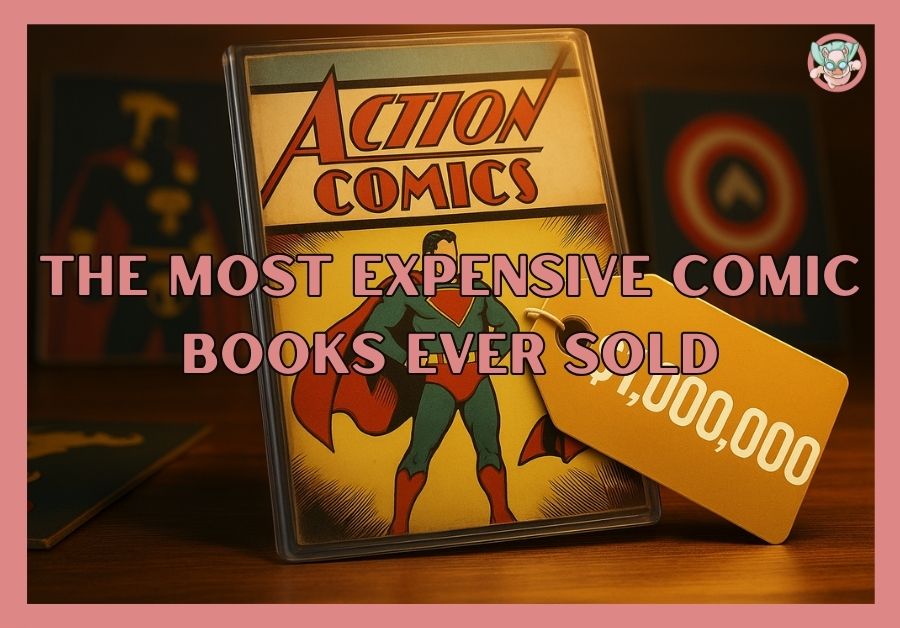
The comic that started it all: Superman’s first appearance. This book regularly breaks records, with copies selling for over $3 million. It’s the cornerstone of superhero mythology. Ace: “The idea of inventing an entire genre in a single issue blows my mind.”
Sources: GCG Comics & Quality Comix
2. Amazing Fantasy #15 (1962)
Spider-Man’s debut. What made him revolutionary was his relatability—Peter Parker was just a kid, with real problems, who happened to get powers. A copy has sold for over $3 million, proving how deeply Spidey resonates with fans worldwide.
Source: GCG Comics
3. Detective Comics #27 (1939)
The first appearance of Batman. Dark, driven, and unforgettable, Gotham’s protector became a global icon. This issue is one of the rarest Golden Age comics. Dapper: “That cover—Batman swinging into action—still feels iconic today.”
Source: Antique Trader
4. Superman #1 (1939)
Superman’s first solo title. It solidified him not only as a hero but as the symbol of the medium. Owning this comic is like holding the foundation of all superhero storytelling.
5. Marvel Comics #1 (1939)
The beginning of Marvel, featuring the Human Torch and Namor the Sub-Mariner. It didn’t just launch characters—it launched a publishing giant that would eventually give us the Marvel Universe.
6. X-Men #1 (1963)
Introduced Professor X, Magneto, and the original X-Men team. Beyond the powers, it became a metaphor for civil rights, difference, and acceptance. The impact of this book stretches far beyond comics.
7. Batman #1 (1940)
First appearances of the Joker and Catwoman, two of the most enduring figures in Gotham’s mythology. Their introduction here set the tone for Batman’s rogues gallery: complex, dangerous, unforgettable.
8. Captain America Comics #1 (1941)
Steve Rogers bursts onto the scene by punching Hitler on the cover. This issue isn’t just rare—it’s a symbol of a nation entering World War II. Chill: “That’s more than a comic, that’s a time capsule of courage.”
9. Fantastic Four #1 (1961)
Marvel’s “First Family” kicked off the Silver Age of Marvel Comics. It introduced the world to a more humanized, flawed kind of superhero—one that paved the way for everything that followed.
10. Incredible Hulk #1 (1962)
The debut of the green giant. Unlike Superman or Batman, Hulk was a hero defined by rage and inner conflict. His popularity—and this issue’s price—show how audiences embraced more complicated heroes.
What These Books Mean to Us
- Ace: “I admire the ambition of these early creators. They weren’t just writing stories; they were building entire universes from scratch.”
- Dapper: “The artistry of the covers—Superman holding a car, Batman swinging through Gotham, Cap throwing a punch—these images became cultural symbols.”
- Chill: “Even decades later, these stories still inspire new heroes. And yeah, that includes us. You can feel the energy that started it all.”
The Super Pig Bros Connection
When we see the astronomical value of these comics, we’re reminded how important storytelling really is. We’re not chasing price tags—but we know our nemesis Unison would love to swipe a copy of Action Comics #1 for his collection.
What inspires us more than the numbers are the legacies. These books prove that stories matter. Motion comics, digital art, or interactive worlds might never hit auction blocks for millions, but they carry the torch—passing inspiration to the next generation of fans and creators.
Conclusion
Comic books are more than collectibles. They’re history, myth, and art rolled into one. The most expensive comics ever sold aren’t just about money—they’re proof of how much these stories mean to people.
For us, they’re reminders of why we started adventuring in the first place. Because every hero, every story, no matter the price tag, begins with imagination—and that’s the most valuable thing of all.
—Ace, Dapper, and Chill