Comics have always been a flexible medium. They’ve shifted from pulp weeklies to glossy graphic novels, from Sunday strips to digital readers. But in the past two decades, something new emerged that sits in between print comics and full-blown animation: motion comics.
Motion comics have carved out their own niche, especially on YouTube where millions of fans watch their favorite stories come alive with sound, movement, and voice acting. But what exactly are they? How are they made? And how do they really compare to traditional comics? Let’s take a closer look.
Table of Contents
Defining a Motion Comic
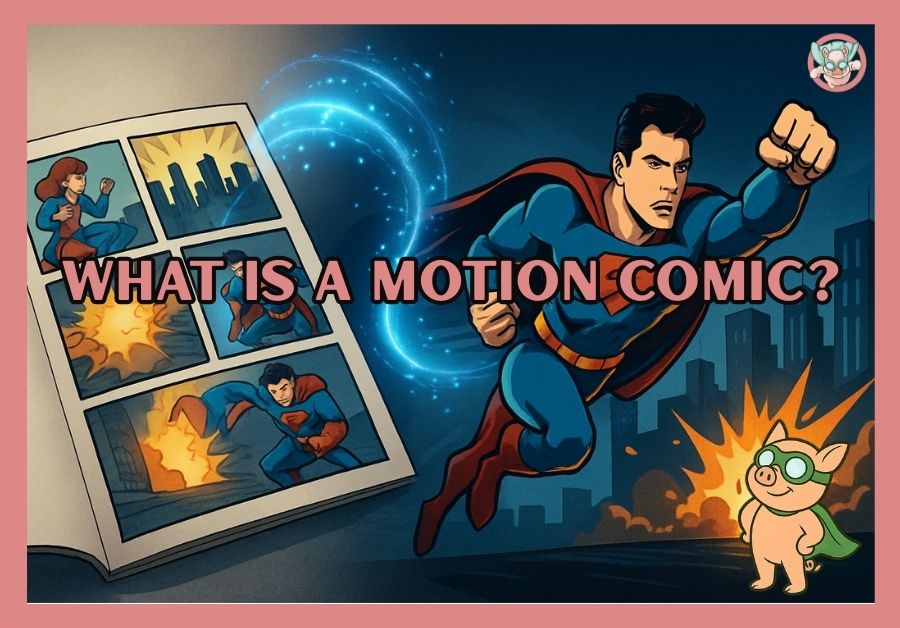
At its core, a motion comic is a hybrid format. It takes original comic book art and adds subtle animation, voiceover, music, and sound effects. Panels no longer just sit on the page; they pan, zoom, and sometimes animate with layered effects. Dialogue bubbles are read aloud, often by voice actors, and the silence of the page is replaced by a soundtrack.
They’re not cartoons, and they’re not just slideshows. They’re a deliberate middle ground—cinematic enough to feel alive but faithful enough to preserve the comic’s original art.
Ace’s take: Think of it as the comic you love, but with a film crew moving a camera through its panels.
If you want quick examples, we’ve rounded up some of the Best Motion Comics on YouTube—a great sampler to see the format in action.
A Short History
The earliest experiments were clunky. In the late 90s and early 2000s, publishers tried adding panel transitions and soundtracks to CD-ROM extras or online previews. It wasn’t until Marvel’s Motion Comics line in the mid-2000s that the medium really took shape. Projects like Iron Man: Extremis and Astonishing X-Men were polished enough to draw fans beyond hardcore comic readers.
Then came YouTube. Suddenly, motion comics weren’t tucked away on DVD extras or niche sites—they were front and center, free to watch, shareable, and easy to binge.
Chill’s take: Motion comics didn’t become popular because they were perfect. They became popular because they were accessible.
How a Motion Comic Is Made
Unlike a traditional comic, a motion comic requires a production process closer to short-form animation.
Pre-Production
- Script adaptation: Writers convert word balloons and captions into voiceover-ready scripts. Sometimes panels get trimmed or rearranged to fit a flowing scene.
- Storyboards & timing: Editors map out how long to linger on panels, when to pan across artwork, and where transitions should hit.
Asset Preparation
- High-resolution art: The original comic pages are scanned or sourced from layered digital files.
- Layering: Characters, backgrounds, and effects are separated so they can move independently.
- Rigging: Simple rigs may be created for facial expressions, gestures, or environmental effects.
Animation & Compositing
- Panel choreography: Pans, zooms, and cuts replicate a camera moving through static artwork.
- Effects: Lightning flashes, smoke trails, or particle effects give depth and atmosphere.
Audio Production
- Voice acting: Either one narrator reads all parts (Watchmen) or an ensemble cast performs (Astonishing X-Men).
- Music & sound design: Original scores or licensed tracks build mood; sound effects punctuate action.
Post-Production
- Mixing & mastering: Audio is balanced against dialogue; transitions are smoothed.
- Exporting: Episodes are cut into web-friendly formats for platforms like YouTube or publisher sites.
Dapper’s take: The magic isn’t in the animation—it’s in timing. Hold too long and it drags. Rush it and you lose the impact of the art.
Adaptations That Defined the Genre
Motion comics often adapt iconic story arcs, preserving the art and dialogue while opening the stories up to new audiences. Some of the standouts include:
- Watchmen — Alan Moore and Dave Gibbons’ classic deconstruction of superheroes. The motion comic is haunting, even if one narrator voices every character. Watch on YouTube
- Black Panther: Who Is the Black Panther? — A bold introduction to Wakanda that predates the MCU film. Watch on YouTube
- Iron Man: Extremis — Sleek art and high-tech themes that felt tailor-made for digital motion. Watch on YouTube
- Thor & Loki: Blood Brothers — Esad Ribić’s painted artwork elevated by atmospheric pacing. Watch on YouTube
- Astonishing X-Men — One of Marvel’s most polished adaptations, with strong voice acting and faithful art transitions. Watch on YouTube
For a deeper dive into the most influential titles, check out our breakdown of Top Motion Comic Adaptations.
Why They’re Popular on YouTube
Motion comics exploded on YouTube for a few simple reasons:
- Low barrier to entry: You don’t need to buy a trade paperback; you just click play.
- Bite-sized episodes: Perfect for short attention spans and quick binges.
- Global accessibility: Subtitles and auto-translation open them to wider audiences.
- Community: Fans share playlists, discuss episodes in comments, and keep content circulating.
- Evergreen relevance: Every time a character appears in a movie, related motion comics trend again.
That accessibility has made motion comics a surprisingly durable format.
Motion Comics vs. Traditional Comics
The biggest difference comes down to control and imagination.
- In a traditional comic, you set the pace. You decide how long to study the art, when to reread dialogue, and how sound effects play in your head.
- In a motion comic, pacing is dictated by the production. You follow the rhythm of the voice actors, the music, and the panel transitions.
Ace’s take: Traditional comics make you a co-creator of the experience. Motion comics make you an audience member.
Both have strengths:
- Traditional comics emphasize imagination and artistic integrity.
- Motion comics add accessibility, immersion, and a cinematic layer of engagement.
We’ve written a full breakdown in The Difference Between a Motion Comic and Traditional Comic if you want a deeper comparison.
Strengths and Limitations
Strengths of Motion Comics:
- Lower cost than full animation.
- Faithful to original art.
- Sound and voice add new dimensions.
- Highly shareable and discoverable online.
Limitations:
- Risk of awkward animation that distracts from the art.
- Weak voice acting can ruin the mood.
- Doesn’t always work for dialogue-heavy or experimental comics.
The Future of Motion Comics
While motion comics may never rival full animation, they’ve found a lasting role. They serve as promotional tools, gateways for new fans, and a bridge medium between comics and film. With new tech like VR and AR, the concept could evolve even further—imagine stepping inside a panel, with the original art around you and the voices in your ear.
Conclusion
So what is a motion comic? It’s a medium that sits between two worlds. It’s not meant to replace traditional comics, nor compete with full animation. Instead, it highlights the strengths of both: the authenticity of the comic page and the immersion of cinematic sound and movement. Motions Comics as well as Graphic Novels are great for kids that hate reading, too!
For fans, they’re a way to see favorite stories from a new perspective. For newcomers, they’re an easy entry point into a vast and vibrant medium. And for creators, they’re an experiment that proves comics can adapt and survive in every era.
Chill’s final word: Motion comics work because they bring people into the fold, not because they’re perfect.
Ace’s final word: They’re bridges—between comics and animation, readers and viewers.
Dapper’s final word: The art always comes first. If a motion comic respects that, it works.
Written by the Super Pig Bros — Chill, Ace, and Dapper